


I caught on a little late, so the project folder only got its first commit on Thursday, November 12, at 17:54: a few design documents and an empty Unreal project. The deadline was Monday, 02:59 in the morning. I had never developed a game in Unreal before, and this time I wanted one with a complete silent film inside it. And an editing program.
On Sunday at 22:26 the last commit went in. The submission zip is 991.6 MB against a limit of 1 GB, so that part was cut close as well.
Film:
The 57-second gameplay video submitted with the entry.
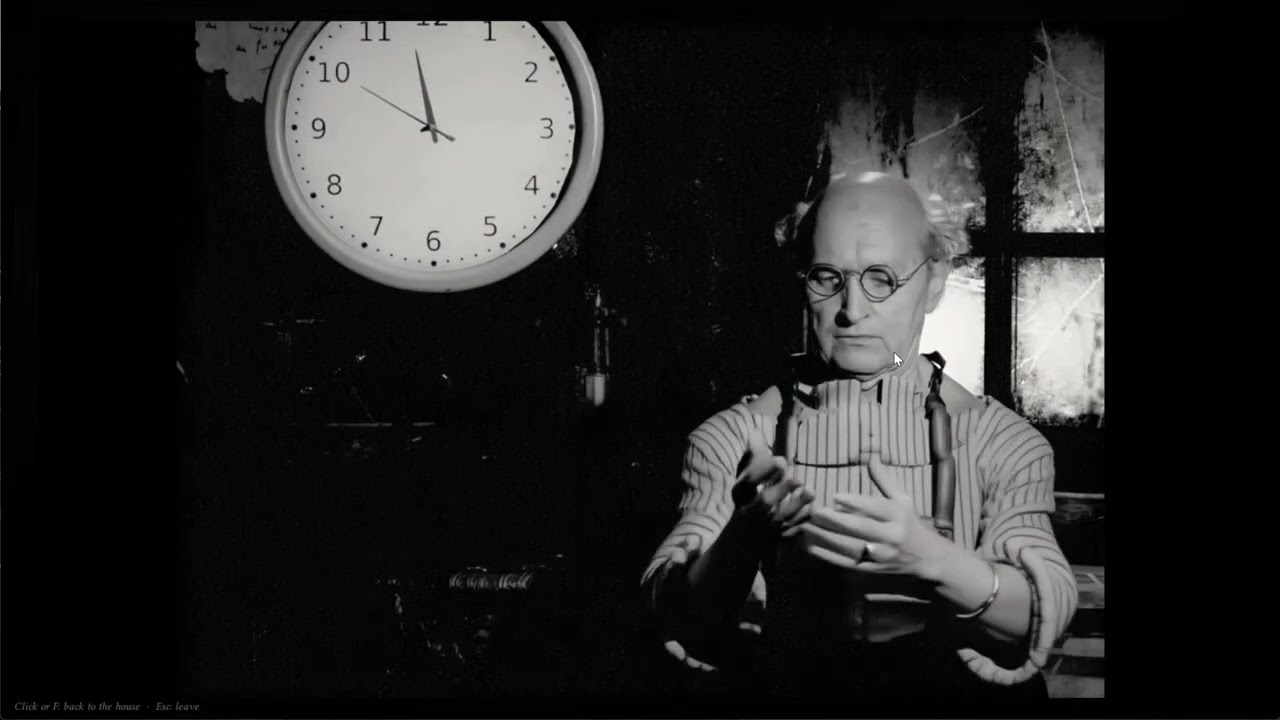
The jam was the 2026 Epic AI MegaJam, and the theme was “Director’s Cut”. Using AI was explicitly encouraged. After a short conversation and a read through the rules, Claude Opus 5.5 pitched three concepts. I did not really like any of them, so I used my own.
You directed a silent picture called Wound by Hand, about a clockmaker who, in his loneliness, builds himself a mechanical companion. The studio cut the twist from the end and released it with a happy ending instead. Years later the reels are yours again, but two of the actors have died, so reshoots are not an option. Everything has to be solved with the footage that exists.
So you first search the studio vault for the takes that were thrown away or locked up, splice them at a Moviola, and then show your director’s cut to a 1930s audience at a test screening. The audience reacts to the film and notices the small and large differences from the original, and the critics write what they think it was about. If your story falls apart, they will boo you out. There are eight front pages, each one an alternative story. Most of them have to be earned the hard way.
The film technology was a deliberate choice too. Unreal Engine is not only a game engine; among other things it is used for filmmaking. If this is an Epic MegaJam, the silent film itself should be rendered in 3D. I knew from the start that this would be slower than AI clips generated from an opening frame made from the character sheets, but I trusted that we would fit into the time. A 3D film inside a 3D game suits Epic Games better, for now, than purely generative content with no 3D in it.

Here the jam’s “Director’s Cut” theme is the game mechanic itself. The same scene means something quite different depending on what it is placed next to, which film schools have been teaching for about a century. Besides the double meaning of the title, it was also a deliberate choice to enter an AI jam with a game, made with AI, in which dead actors cannot be brought back digitally. The big studios were fairly quick to put that particular AI technology to use.

More of the game: the title on the screen, two finds in the vault, the clapper lock on the cage, the editing bay and the vault in the final build.
The game is on itch.io, with the full dev log attached.
Film:
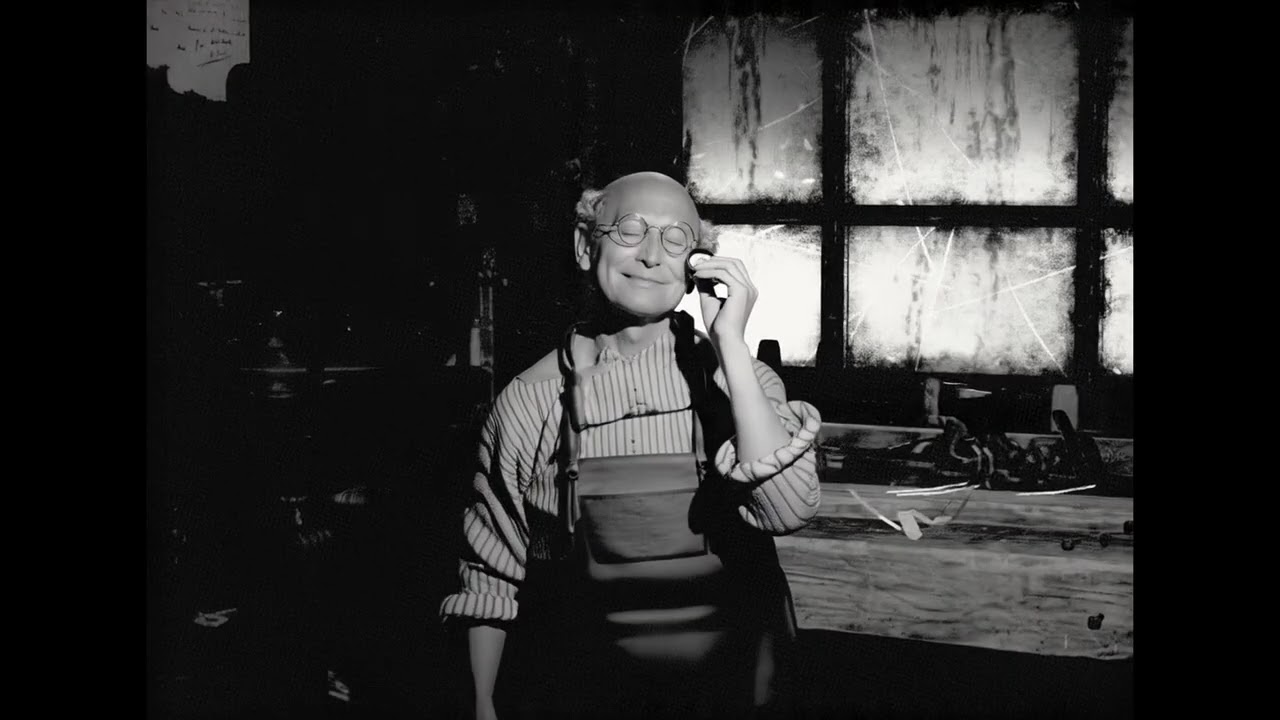
The studio's cut, the film the player starts from: 34 clips and the warm piano mood.

- Me: the concept, the technologies, every pick between candidates, the notes, the playtesting and the veto. Also the changes of technology, the simplifications and the speed-ups along the way.
- Claude Code: the code, the tools, the pipeline scripts, the design writing and the checking. The story was worked out with me in a separate session, on a Fable 5.2 model.
- Open-weight models on my own render nodes, through the same ArchUpgrade pipeline I use for studio work: style frames and interface plates, sound effects, the intro narration, the piano score, and image-to-video for some of the clips.
- Sourced assets: MetaHuman presets for the two human actors, and Fab packs for the sets and the stock animation. The jam rules want these declared, and they are not scored.
In numbers: 131 commits in four days (10, 25, 59 and 37), 5,350 lines of C++, and 140 Python scripts with about 17,000 lines between them. Most of it was written by Claude Opus 5.5 agents. The dev log is 1,757 lines, and the agent wrote that too, because at the start I set up a hook that refused to let it finish a task while the log was older than the files.

The mechanical man: the generated design sheet I picked, the scripted Blender model checked against it, and the head.
Compare:
The opening shot: the generated style frame and the frame that was rendered.
Compare:
The rescue. The style frame promised more than four days could deliver.
The cast: MetaHuman presets dressed and lit, and two more style frames.
The game contains no sourced audio and nothing recorded live. The 75 audio files are all generated, on the same render nodes as the pictures.
- Sound effects. The first batch was 27 sounds in 41 takes: film cans, splices, a pencil in the notebook, lockers, footsteps on concrete and on the stair, and five room tones that loop. Two takes came out nearly silent and were dropped by a level check. Walking down to the vault crossfades one room tone into the other.
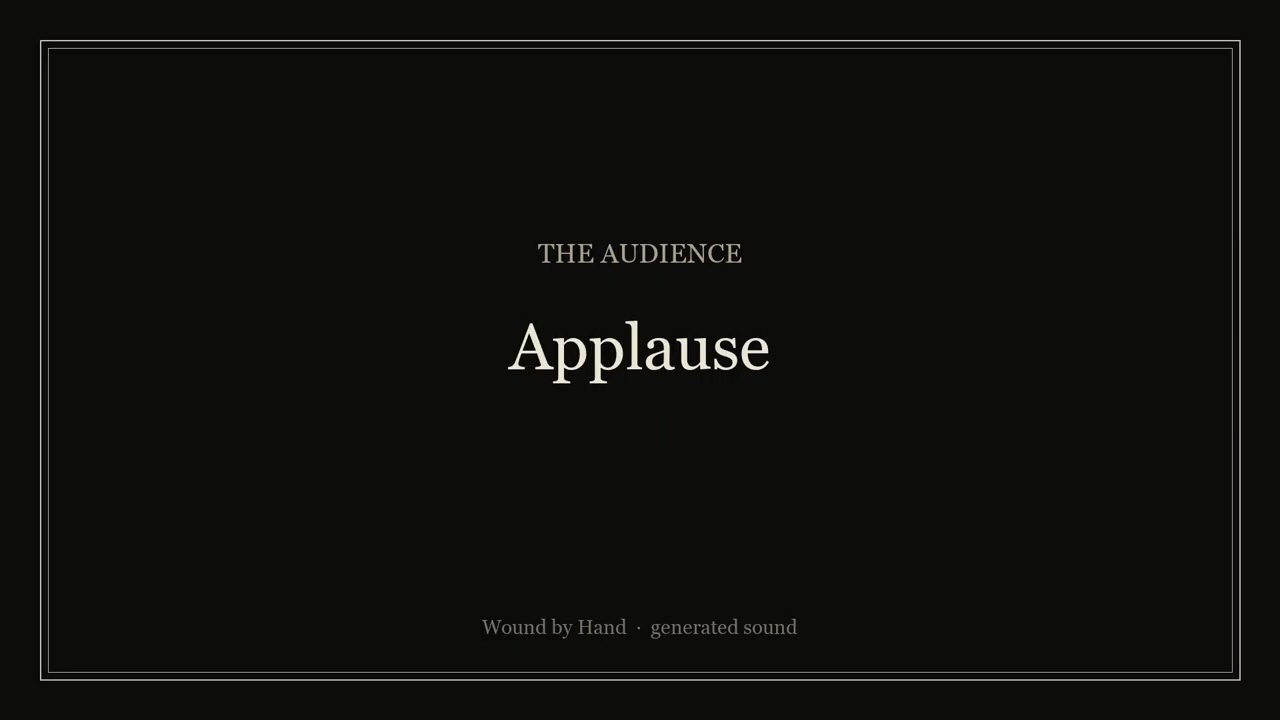
- The audience. A second batch of 16 cues gave the picture house a voice. The house settles, the curtain opens and the projector runs up. The audience gasps at the revelation, murmurs at bad news, laughs when the crew walks into shot, and at the end applauds, cheers or boos, depending on which film you made.
- The narrator. The intro is 19.5 seconds of generated speech, cloned from a reference voice. It first played over text cards. I had those replaced with ten shots from the studio’s cut, each one cut at a pause in the narration.
- The piano. Three moods, warm, dark and eerie, about two minutes each. The ending decides which one plays.
Two things went wrong here as well. A sound conversion silently wrote an empty file until the script was made to check its own output. The model meant for the single piano note in the cage was not installed on the node, so the sound-effects model played the note, and a frequency check confirmed that it was one.
For a while the log described the mix as “not yet heard by a human”. When I did listen, the projector was of course too loud.
Film:
The narration, a selection of the sound effects, the audience and the three piano moods, each with a title card.
- Rules before content. The story started as a ruleset, then a document was written from it, then a script that checks every rule, including that each example cut produces its intended ending. The game’s rules engine was ported from that script, and the clip table is generated from the story document. When the story grew from 61 clips to 68 on Saturday, the checker said within seconds whether the stories could still come together.
- Everything is a script. The mechanical man was built in Blender by a Python script, without me touching the interface. A full rebuild took about two seconds, so a note like “more cute, more 1920s” became a few changed numbers and a new preview. The sets, costumes, shots, renders, encodes and the package all work the same way, down to the script that zips the final package, which fails if the result is over 1 GB.
- Sessions in parallel. While I wrote the rules engine with one session, another was already modelling the robot and a third fitted the costumes. The limit was how fast I could look at results.
- Evidence, not reports. Contact sheets, before-and-after sheets, 25 automated tests, and the packaged build played both by an autopilot and by hand. The Shipping build was repackaged twelve times.
- A working build at all times. The first packaged build ran on Saturday evening. From then on, every change had to end in a new one, and I had planned on Friday what to cut if we fell behind.
- A change of technology, or a detour. One pitfall of working with AI agents at the moment is that they do not always notice when they cannot solve something in time. They look for a way through persistently, but they cannot always see themselves from outside, stuck in time-consuming loops and getting no further with some small detail. That detail may well be irrelevant to the production as a whole. A person has to recognise these in time and push the process on: with a quick change of technology, by approaching the problem from another side, or by removing or bypassing the detail. This matters most on projects with short deadlines.

Compare:
The editing desk. The text buttons became objects on the desk.
Compare:
The door to the vault: the first version of the editing bay, and the final build.
Compare:
The exit, first version and final build.
3D character animation. An agent keying poses by numbers cannot see what it made. Sunday went on review rounds, clip by clip and frame by frame. In the plan for one shot the neighbour holds a key up to the lens. My note was “not visible at all”. The agent’s own measure said 67% of the key was in view. The fingers it had calculated were about 5 cm from where the engine actually put them.
MetaHumans. The exported bodies arrived without a torso, because the skin hidden under clothing is removed. The apron and the shawl had nothing to be fitted to.
Face capture. The plan was to perform the close-ups myself in front of a webcam. The script got written and never tested. Stand-in performances from the animation packs are what shipped. We will try it on the next one.
The last evening. With hours left, a few scenes were still unacceptably bad. I had to redirect eleven clips from animation rendered from the 3D model to an AI video model. The first frame was still staged, lit and rendered in Unreal with our own characters. The generative video model (LTX 2.5) only invented the motion. In a few minutes LTX generated continuous, believable movement that hand keying had not come close to in hours. LTX is not perfect either: at times it gave the robot a growth on its shoulder, a face on its blank head and a flesh arm, and it let the unconscious clockmaker open his eyes. About one take in two went the wrong way, but with generation running in parallel on several GPUs I still had perfectly usable clips within a few minutes.

Film:
The generated takes, failed attempts included.
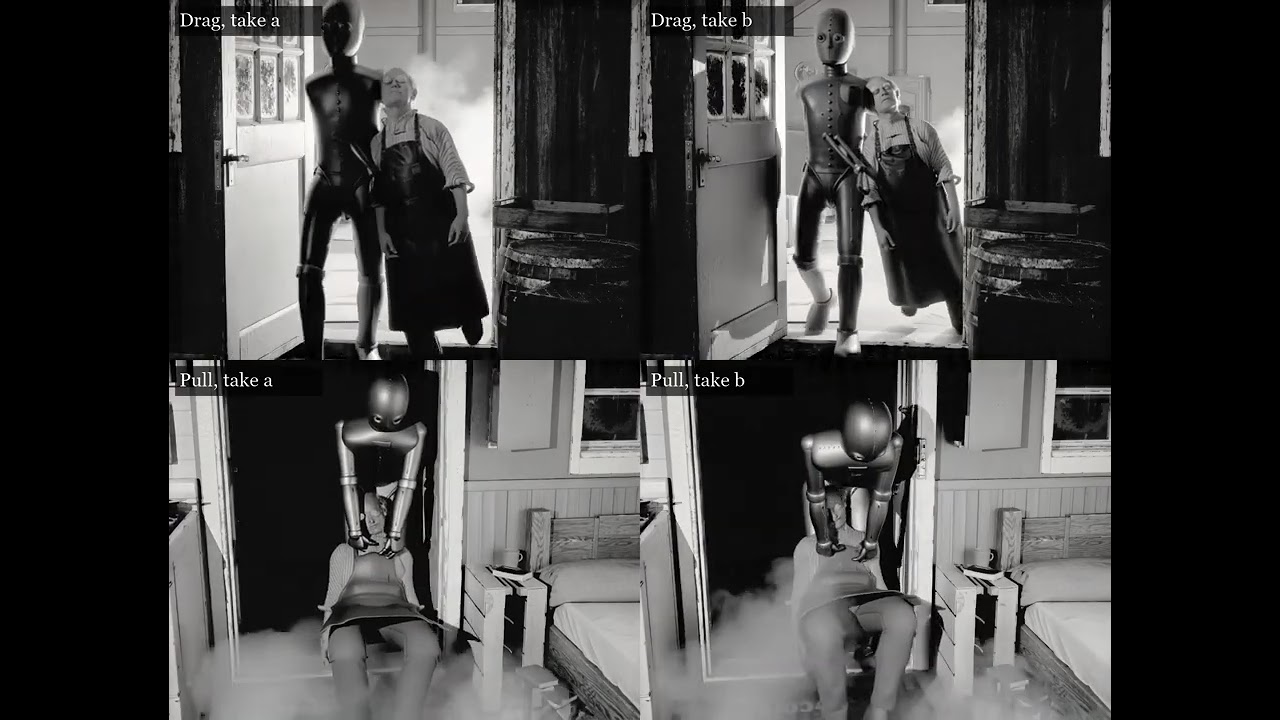
Take sheets, as the agent laid them out for me to pick from.
The dev log records these as they happened. A selection:
- Every cut was incoherent. On its first run the rules engine returned the “incoherent” ending for every possible film, the studio’s own version included. Every clip lookup was failing, probably because of live code patching. The lookup table was replaced with a plain scan over 61 clips, which was simpler anyway.
- Every splice stuttered. At each cut the new clip held its first frame for about one frame too long. The video player needs roughly a frame to start. The fix was to start the next player during the last frame of the outgoing clip and keep it hidden.
- The clockmaker grew a beard. When an earlier style frame was used as the base image, it overpowered the character sheets. The robot’s head went back to an old design and the clockmaker acquired a beard. Those frames were redone on a neutral grey canvas.
- The shirt that read as skin. The clockmaker’s shirt rendered pale. Its material had silently failed to compile in Unreal, so the renderer used the engine’s default. The second attempt at a pinstripe failed for a different reason. The third one is in the film.
- The carry. The shot where the robot gets the clockmaker out of the fire was re-posed three times, as a hug, a drag and a pull, and was still not right. That is why I turned to the video model in the end, which then quickly solved a few problem shots.
- A test that deleted a test. A new test was given a name that turned an existing test into a group, and the stair test quietly dropped out of the suite. The count of passing tests looked fine.
- A whole set re-imported. Two settings did not reach the editor, so a script meant to import a few files re-imported the entire screening room. It was reverted from version control.
- The first Shipping build did not compile. A shell script had turned an escaped line break inside a string into a real one.
- The key shot. The visibility measure that read 67% was thrown out. The fingers are now read from the engine, not calculated.
Failed images, clips and 3D models. There were a lot of them. At times I did not know whether to laugh or cry.
The carry, posed three times by hand before it went to the video model: a hug, a drag and a pull. The last sheet sets the pose against the previs.
Each of these was a decision, and each of them shows.
- No path tracing. The spec said the video of the film’s shot scenes would be path traced inside Unreal Engine. On Friday that became the engine’s real-time lighting, to be reconsidered once all the animation was done. It never was.
- No body capture, then no capture at all. Full motion capture was cut to facial capture on Friday, but the face takes were never recorded. So the character animation comes from stock animation packs with hand-keyed corrections on top.
- A smaller editor. Trimming, colour grading, speed changes and music editing were cut from the game itself on the first day. The player gets one track, whole clips, and each clip can go on the timeline only once.
- No real score. I had a silent-era cue sheet designed, with moods that follow the cut. What shipped is one mood per ending and music that exists inside the rooms. The generated piano takes share no melody, so there is no theme.
- Scripts, because the connection was down. The plan was to drive Blender through a live connection. For some reason it did not work, so everything was built by scripts with no interface. This turned out better than what was in the plan.
- One upscaler feature. DLSS is in; Frame Generation and Ray Reconstruction are not: neither was needed, and one of them would have added a file to a zip that was already dancing on the size limit.
- Eleven AI-generated clips. In the dev log they are filed under “running out of time”, which is accurate.
- The agent’s own “done”. I accepted only what I had seen: on a sheet, in the played build, or in separate video files.
- Taste. Three concepts were pitched and none was distinctive enough. Casting, the robot’s face and the choice between takes were all mine. The agents are excellent at producing candidates; picking between them is, for now, human work.
- The result. The game was developed and tested on one machine with an RTX 4090. The judging has not happened. I do not know yet whether it is fun for anyone other than me.
It is not quite true that “AI made a game in four days”. The sets and the human actors are sourced, and those four days were fairly dense. Even on the “compulsory” weekend outing with Lilike I had to look in on Claude Code from my phone now and then, to see that everything was going well.

What I actually signed off: a dense frame sheet from the second review round, and a contact sheet of the re-shot clips.
Do not take these as gospel: I am certain to be wrong about some of them.
The slow part will move. This time it was animation, and on the last evening a video model had to take over eleven clips. At the next jam some other, far more complicated process will get stuck, and I will find another way around that one too.
Making gets cheaper, judging does not. 131 commits in four days is already more than I could read line by line, so I reviewed results. As agents work longer on their own, the checking side is what limits the speed. The tools I would want next are for looking, not for making.
The scope of one person keeps growing. A solo entry now has the scope of a small team. If everyone has the same agents, the code stops being what separates two entries, and what is left is the idea and the judgment. I assume jam rules and scoring will follow.
For the studio. Scripts, an agent and a game engine make a one-off interactive piece for a single building plausible: something with rules and a story, beyond a walkable tour. I can now estimate what that takes. Whether a client wants it is a separate question.
Dependence. The models that made the pictures, the sound and the motion ran on my own machines from the start, with open weights. The agent that directed them did not. For now, the part I cannot run myself is the part doing most of the work, and I do not want to run it myself either, as long as Claude is available and affordable. I expect the gap in capability between open, locally runnable models and closed ones to keep narrowing. And although new hardware is irrationally expensive because of the AI bubble, the hardware I already own runs more capable AI models month by month.

If any of this is relevant to a project of yours, get in touch.